Eucharistic Congress
A historic event that will feed your soul and inspire your faith in a radical way


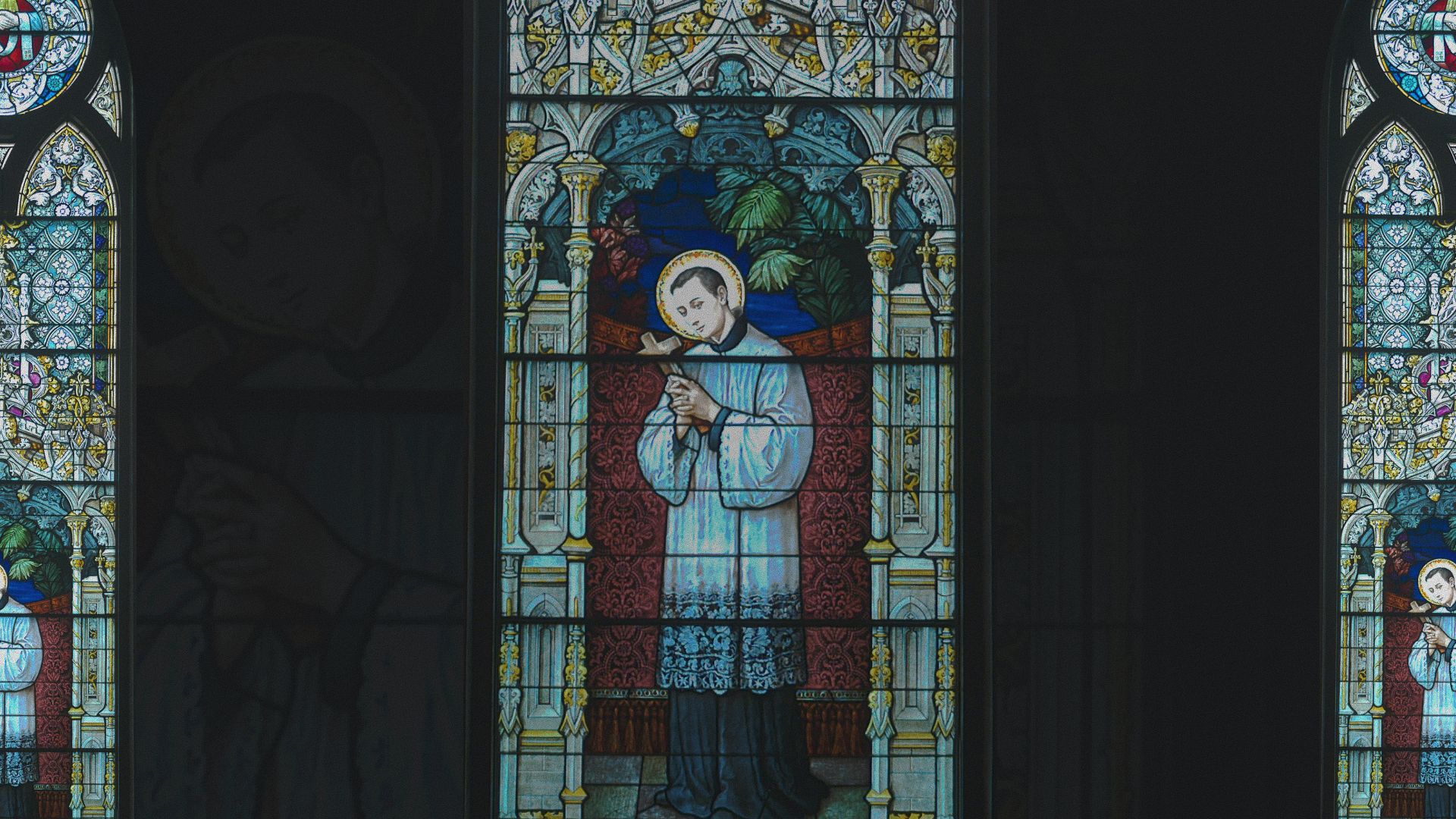
If light was ever said to sing it would be when shining through stained glass. So too does God sing to us through his saints— but only if we take the time to listen. In the spirit of listening, discover St. Aloysius’ life, a saint memorialized in St. Anthony’s stained glass.
St. Aloysius (pronounced Al-oh-ISH-us), the oldest son of Ferdinand Gonzaga and prince in the Holy Roman Empire, was born on the 9th of March, 1568. He began life with great love of Christ despite the opulence of his inheritance. His first words were Jesus and Mary’s holy names, his teacher was his devout mother (Martha Santena), and his prayers were fervent.
His father, being a stately man, wished him to pursue a life in the military. However, it was at the age of 7, beside his father, before thousands of troops, that his most sorrowful memory was found. Soldiers profaned the name of God and taught young Aloysius, among other foul words, to do the same (though he did not know what they meant.) He never forgot this offense and it humiliated him for the rest of his life. Perhaps partly because of this occasion but also for his growing interests in divine things, his interest in matters of the military never grew.
Around the age of 12, already educated in the saints and in theology, he decided he would resign his noble inheritance, the title of marquisate at Castiglione, to his brother. Sickness took him for a time and he further dedicated himself to prayer. He acquired a great gift of mental prayer and was reported to say a Hail Mary at every station he took.
In 1580, St. Charles Borromeo visited the town Aloysius was staying in and found his piety remarkable. Upon learning that Aloysius had never received the Eucharist, St. Charles began preparing him for first communion, asking Aloysius to receive it frequently and counseling him in other matters of piety. Aloysius recalled meeting this great saint with wonderful joy.
His devotion to God grew more fervent and before 18 years of age he decided he would join the Jesuit order. However, his father denied him many times. Their relationship grew strained until the nobleman reluctantly allowed it, writing “Dear son, your choice is a deep wound in my heart. I ever loved you, as you always deserved. In you I had founded the hopes of my family, but you tell me God calls you another way. Go therefore, in his name, whither you please, and may his blessing everywhere attend you.” His father died 6 weeks after Aloysius took the habit and not without being effected by his son’s devotion. In the last weeks of his life he devoted himself greatly to prayer.
Arriving in Rome, Aloysius’ mortifications had grown so great that he was limited in their practice by obedience to the Jesuit order. Despite his time in prayer being reduced, he grew closer to God in obedience to his superiors. Sickness was regularly with him but he counted it to the benefit of his soul.
Nearly 6 years after entering the society, plague broke out in Rome. Aloysius’ foresaw his death and his union with Christ in it and so he asked to care for the dying. He catechized them, cared for their wounds, and never failed to joyfully take duties that most despised. Aloysius fell sick. For 3 months he suffered from the disease and a succeeding fever. He learned in an ecstasy that he would die on the feast day of Corpus Christi. Truly he did after receiving the anointing of the sick and saying “Lord, into thy hands I commend my spirit,” and repeating the first word he ever spoke— the name of Jesus.
The famous hagiographer Alban Butler reflects “When we see a young prince, the darling of his family and country, sacrifice nobility, sovereignty, riches, and pleasures, the more easily to secure the treasure of divine love, and of eternal happiness, how ought we to condemn our own sloth, who live as if heaven were to cost us nothing!”
A historic event that will feed your soul and inspire your faith in a radical way
Looking for more information about our ministries, or have other stewardship ideas?